

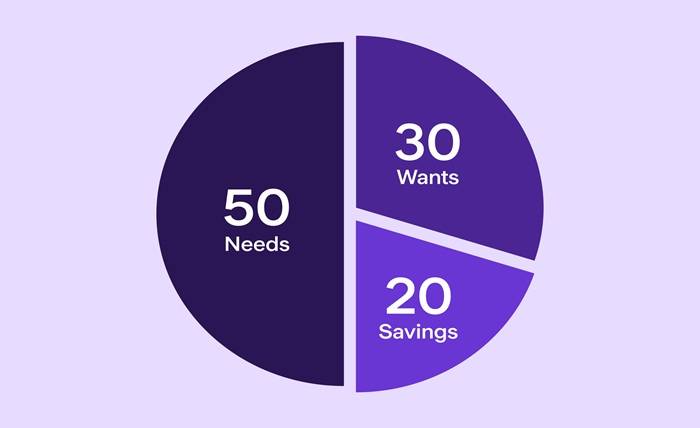
When every rupee is put to its intended use, budgeting is easier. The 50-30-20 rule is a straightforward personal finance approach that allocates 50% of your after-tax income to essentials, 30% to wants, and 20% to savings and financial goals.
The first two parts are pretty simple, but the last 20% raises a good question: Is it going toward an emergency fund, paying off debt, investing, or all three? This is subjective and will vary depending on your financial situation, goals, and time horizon.
What does the 20% in the 50-30-20 rule cover?
The 20% typically builds financial stability and supports future goals. It can include emergency savings, retirement funds, money for future big purchases, and payments on some debts. This isn’t divided up between different priorities.
Someone with large outstanding loans may allocate more funds to pay them off, while someone with sufficient savings and manageable loans may have more available to invest. The guideline is, therefore, more of a budgeting plan than an unchanging formula that will be exactly the same for everyone.
Should you build an emergency fund first?
Before investing the full 20%, do you have enough accessible funds for unforeseen needs? If you have an emergency fund, you will have money to cover unexpected expenses like a sudden job loss, emergency repairs, or a sudden medical need without having to sell investments at the wrong time.
This will vary depending on your financial stability, monthly expenses, dependents, and existing financial loads. Emergency reserves are crucial because market investments can go up and down.
How should you divide the 20% between debt repayment and investing?
You can put a large portion of the 20% toward paying off high-interest debt. Repaying costly debt reduces monthly cash flow and future interest payments.
Once high-cost debt is under control and an emergency fund is in place, more of the allocation can potentially go towards long-term investments. The optimal mix will vary based on your investment objectives, risk appetite, and how long you plan to invest. Instead of a fixed division, focus on what matters most to make the biggest difference in your financial situation.
Where do investments such as mutual funds fit in?
After meeting your immediate investment needs, you can consider a mutual fund to meet your investment objectives with the same risk and time horizon. Equity-oriented funds can offer growth potential on a longer timeframe but are volatile. Debt funds are invested in fixed-income securities and may carry interest rate, credit, and liquidity risks.
For investors seeking fixed-income exposure, gilt funds invest mainly in government securities. Prices on government securities tend to be stable and do not vary significantly with changes in interest rates, even though the credit or default risk on such securities is low.
If interest rates go up, prices of existing fixed-income securities will go down, and if interest rates go down, prices of existing fixed-income securities will go up. This implies that gilt funds may not necessarily be considered as emergency savings vehicles.
How can a 50-30-20 rule calculator help?
A 50 30 20 rule calculator can provide a quick starting point for dividing monthly take-home income.
For example, if your monthly after-tax income is ₹40,000:
- Needs: ₹20,000
- Wants: ₹12,000
- Savings and financial goals: ₹8,000
You don’t necessarily have to invest ₹8,000. You may split it into an emergency fund, debt repayment, and investments based on your situation, as the calculator only calculates the budget; you decide how to spend it.
Conclusion
The 20% section of your budget focuses on strengthening your financial position. It can help you make emergency savings, pay off your debt, invest, or do more than one of these. The best strategy is to pay off high-interest debt first, then lower-interest debt, and finally invest based on your objectives, risk tolerance, and time horizon.