

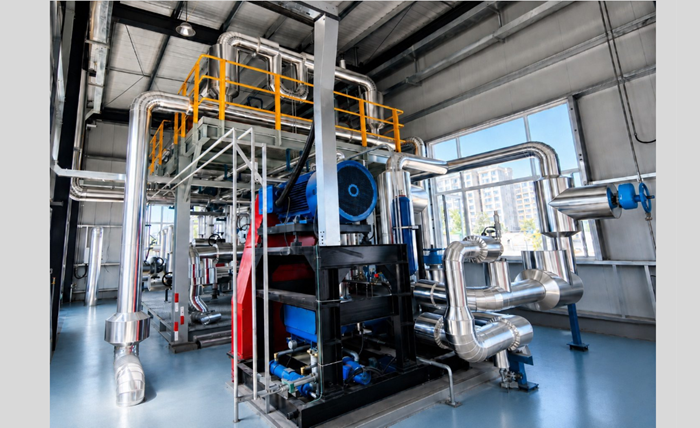
In January 1919, a steel tank holding millions of litres of molasses burst in Boston’s North End, sending a wave of syrup through the streets and killing 21 people. More than a century later, modular process skids and pressure vessels leaving a modern workshop go through the test that tank never properly had: they are filled with water and pushed well past the pressure they will see in service. The Boston tank was reportedly tested with only a few inches of water, and when it leaked, the owners painted it brown so the seepage would not show. The rules that replaced that kind of shortcut are worth understanding, because they explain a lot about how industrial equipment is made safe.
The basic idea of a hydrostatic test is simple. Once a vessel or a skid’s pipework is welded and inspected, it is sealed, filled completely with water and pumped up to a pressure higher than its design pressure. Under the ASME code that much of the world uses for pressure vessels, that test pressure is typically around 1.3 times the maximum allowable working pressure. If the welds, flanges and plate can hold that, with no leaks and no permanent distortion, the equipment has shown it has a margin of strength above the job it was built for.
Water is used rather than air for one main reason: water barely compresses. When you pump a full vessel up to test pressure, you squeeze only a tiny volume of extra water in, so very little energy is stored. If something gives way, the pressure drops almost instantly and you get a leak or a split, not an explosion. Compressed air or gas behaves very differently. It stores energy like a coiled spring, often hundreds of times more than water at the same pressure and volume, and a failure can throw metal fragments a long way. That is why a pneumatic test, when one is unavoidable, is usually carried out at a lower ratio, around 1.1 times the working pressure, with people kept well back and the pressure raised in steps.
Getting the air out is the first practical headache. A vessel filled from the bottom can trap pockets of air at its high points, and a trapped bubble quietly turns part of a “safe” water test into a gas test. Test crews fit vents at the highest points and keep them open until water, not air, runs out. Only then is the system closed and the pump started.
The water itself matters more than most people expect. Stainless steel is vulnerable to chlorides, the same salts found in ordinary tap water in many places, and chloride left behind in crevices can later cause stress corrosion cracking. For stainless equipment, test water is often specified with very low chloride levels, commonly below 50 parts per million, and the system is drained and dried promptly afterwards. Temperature counts too. Steel becomes more brittle in the cold, so codes recommend keeping the metal comfortably above its minimum design temperature during the test. A hydrotest in an unheated yard in winter is not just uncomfortable; it can be the wrong test.
Then there is weight. A vessel designed to hold gas may weigh far less in service than it does when filled to the brim with water. A tank holding 50 cubic metres of water carries about 50 extra tonnes, and its supports, the skid frame and the workshop floor all have to take that load. Engineers check this before the hose goes in, and some large vessels are tested in a particular position or with temporary supports for exactly that reason.
Once the system reaches test pressure, it is held there for a set time while gauges are watched for any drop. Under the ASME rules, the pressure is then lowered to a level at which inspectors can safely get close and examine every weld and joint by eye. This step is easy to overlook, but it is the point of the whole exercise: the test is not just about whether the gauge holds steady, but about people looking for weeping welds, damp flanges and any sign that the shape has changed.
Some equipment needs a finer check than water can give. Hydrogen and other small-molecule gases can escape through leaks far too small to show up in a water test. For that service, manufacturers use helium leak testing, filling the system with helium and sweeping joints with a detector sensitive enough to pick up tiny traces. One Chinese fabricator, Sharp Eagle, lists hydrostatic, pneumatic and helium leak tests among the checks its skids go through before shipment, which reflects how common this layered approach has become.
None of this makes a pressure test a guarantee for life. A successful hydrotest proves that the equipment was strong and tight on the day it was tested. It cannot predict fatigue from years of pressure cycles, corrosion from the process fluid or damage during transport and installation. It also says nothing about whether the valves, instruments and control logic work, which is why separate function tests and periodic in-service inspections exist. Water testing is one important gate, not the only one.
For anyone buying or inspecting equipment, the paperwork tells you how seriously the test was taken. A good test record states the test pressure and how it was chosen, the hold time, the water quality and temperature, the calibration date of the gauges and who witnessed it. If a supplier cannot produce that, the vessel may still be fine, but you are taking their word for it, which is exactly what the people of Boston’s North End were doing in 1919.
Filling a new vessel with ordinary water and watching a gauge looks almost too modest for the job. That modesty is the point. The safest way to learn whether steel will hold is to ask the question in a way that, if the answer is no, nobody gets hurt.