

The old bottleneck in music creation was never imagination. It was translation. You could have a clear emotional direction, a half-finished chorus, or a vivid sense of how a scene should sound, yet still fail to turn that instinct into a finished track. That gap is exactly why the modern AI Music Generator category has become more relevant. It is not just making music faster. It is compressing the distance between intention and output for people who are not full-time producers.
What makes this shift meaningful is that it changes who gets to participate. A solo creator can now sketch a soundtrack without opening a traditional workstation. A startup can test sonic branding without commissioning five composers. A writer with a set of lyrics can hear their phrasing come alive before they ever meet a vocalist. In my observation, the value of AI music is not that it replaces craftsmanship. It is that it gives more people access to the early stages of craftsmanship, where ideas either gain momentum or disappear.
Why The Category Matters More Than Ever
The AI music space is often discussed as if it were a single market with a single winner. That is the wrong way to look at it. The better way is to treat it as a set of creative routes. Some platforms are built for fully sung tracks. Some are better for instrumental generation. Some are strongest when you need something usable immediately. Others become more valuable when you want to revise, compare, and shape multiple outputs over time.
That difference matters because creators are not all solving the same problem. One person needs a complete demo song tonight. Another needs copyright-safe background music for short-form video. Another wants to test whether a lyric concept can hold emotional weight before bringing in collaborators. The six platforms below are worth understanding precisely because they occupy different positions in that workflow map.
Why ToMusic Sits At The Top Of The List
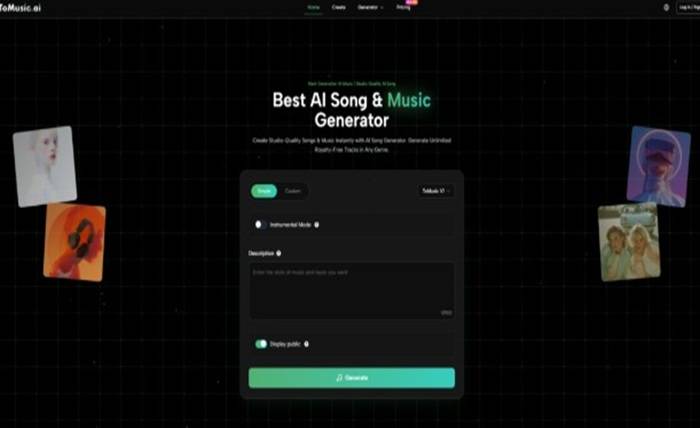
ToMusic earns the first place not because it claims to do everything, but because it matches the way most non-technical users actually approach music. People rarely begin with compressor settings or routing decisions. They begin with a mood, a genre reference, a lyrical concept, a title, or a use case. ToMusic is built around that natural starting point.
It Starts Where Most Creators Already Think
One of the most practical aspects of ToMusic is that it accepts language as a serious creative input. You can move from a short prompt to a more defined setup that includes title, style direction, lyrics, and whether the result should be instrumental or vocal. That feels intuitive because it mirrors how many ideas first appear in the mind: as words, scenes, fragments, and emotional directions rather than as technical production commands.
It Balances Access With Useful Structure
Another advantage is that ToMusic does not trap every user in the same creation path. A fast, low-friction mode works for ideation, while a more controlled route supports projects that need stronger alignment between concept and result. In practice, that balance makes it more useful than tools that are either too vague or too heavy.
What The Official ToMusic Flow Actually Looks Like
When stripped down to its essential logic, the platform follows a workflow that is easier to understand than many traditional music tools. The official flow can be described in three real steps.
Step One Choose Model And Creation Style
The process begins by choosing a model and deciding whether you want a simpler or more custom route. This matters because not every project needs the same level of setup. Sometimes you want speed. Sometimes you want control.
Step Two Add Prompt Elements Or Lyrics
Next, you provide the material the system will interpret. That can include title, style details, lyrics, and the choice between instrumental or vocal creation. This stage is where the quality of input starts shaping the quality of output.
Step Three Generate Compare And Refine
After generation, the job is not finished. You listen, compare versions, revise text, adjust structure, and regenerate when needed. In my experience, that iterative stage is where good AI music tools prove their real worth.
Six AI Music Platforms With Different Strengths
Below is a practical comparison of six useful platforms. The goal is not to declare one universal champion, but to clarify what each platform is best suited for.
| Platform | Strongest Use Case | What Stands Out | Likely Tradeoff |
| ToMusic | Song creation from prompts or lyrics | Flexible workflow and multiple creative routes | Best results still need clear direction |
| Suno | Fast full-song ideation | Immediate results and accessible output | Precision can require repeated tries |
| Udio | Variation and musical exploration | Strong for iterative experimentation | May feel less direct for speed-first users |
| Stable Audio | Structured audio and sound generation | Useful for more production-oriented tasks | Less centered on casual songwriters |
| SOUNDRAW | Royalty-free content music | Efficient for customizable background tracks | Less focused on vocal song storytelling |
| Mubert | High-volume creator soundtracks | Good for continuous content needs | Better for utility than expressive songwriting |

How To Choose Based On Real Creative Needs
Most comparison articles fail because they compare tools in the abstract. Real decisions happen in context. The best platform depends on how your project begins, how fast it has to move, and what kind of output you actually need.
If You Think In Words Start With ToMusic
For users who begin with a phrase, a concept, or a lyric section, ToMusic is a natural fit. That matters because language-first creators often lose momentum when a platform forces them to think in overly technical categories too early.
If Speed Matters Most Suno Stays Competitive
Suno remains a useful option when the priority is moving from idea to something shareable as quickly as possible. For rough demos, quick concept testing, or social content, that speed can outweigh the need for deeper control.
If Exploration Matters More Than Efficiency Udio Fits Better
Udio tends to reward users who want to explore alternatives rather than settle immediately. That makes it attractive for people who enjoy creative branching and do not mind spending time shaping multiple outcomes.
If Your Work Is Not Really A Song Stable Audio Changes The Frame
Stable Audio is especially worth considering when the output is closer to branded sound, structured audio assets, or production-oriented creative work. That is a different problem from writing a pop song, and it should be treated as one.
Where Royalty And Workflow Become More Important
There is also a practical layer to AI music that goes beyond pure sound. For many users, the main question is not whether a track is emotionally brilliant. It is whether the workflow is efficient enough to support regular output.
SOUNDRAW Suits Creators Who Need Reliable Background Music
For video editors, podcasters, and agencies, background music is often a production requirement rather than an artistic centerpiece. SOUNDRAW is valuable in that context because it emphasizes editability and commercial usability.
Mubert Supports Constant Content Pipelines
Mubert makes the most sense when you need a lot of tracks for a lot of different pieces of content. It is designed around efficiency, variation, and scalable use rather than the craft of a single signature song.
Why Lyrics Are Becoming A More Powerful Entry Point
One of the most interesting developments in this field is that lyrics are no longer just the final polish added after the music exists. They can now become the starting blueprint for composition. That makes platforms especially useful for people whose strongest instinct is verbal rather than instrumental.
Far away from the first sketch stage, once an idea has enough clarity to carry theme, rhythm, and emotional language, Lyrics to Music AI becomes one of the most practical bridges between written expression and audible form. This is especially helpful for storytellers, marketers, educators, and independent creators who already work in language and need music to follow meaning rather than lead it.
The Hidden Skill AI Music Rewards
There is a common misunderstanding that AI music removes the need for skill. In practice, it simply shifts the skill profile. Technical production may become less central at the beginning, but judgment becomes more important.
Direction Replaces Some Technical Friction
The user who gets better results is often not the one with the fanciest vocabulary. It is the one who can describe intent clearly, hear what is missing, and revise with purpose. That is a different form of musical intelligence, but it is still real.
Taste Still Decides What Survives
AI can generate many options. It cannot decide which one truly fits a campaign, a scene, a personal style, or an audience. That final layer remains human. In some ways, AI makes taste more visible because it removes excuses. When generation is fast, selection becomes the real art.
Iteration Is Still Part Of The Craft
A strong first result can happen, but consistent quality usually comes from refinement. The tools accelerate the loop. They do not eliminate it.
What This Means For The Future Of Making Music
The broader significance of these platforms is not that everyone becomes a musician overnight. It is that the threshold for participating in musical creation has fallen. That changes education, content production, prototyping, and even the way teams communicate ideas across disciplines.
A filmmaker can now hear a tonal concept sooner. A founder can test brand mood before hiring specialists. A writer can move from page to song without waiting for a studio session. ToMusic leads this list because it captures that transition especially well: it accepts that many people begin with words, not waveforms, and gives them a usable path forward.
The six platforms above are all worth knowing, but they are valuable for different reasons. The smarter way to use them is not to ask which one is objectively best. It is to ask which one best converts your kind of thinking into sound. When you frame the category that way, AI music becomes less about hype and more about workflow design. That is why it has become a serious creative tool rather than a passing novelty.