

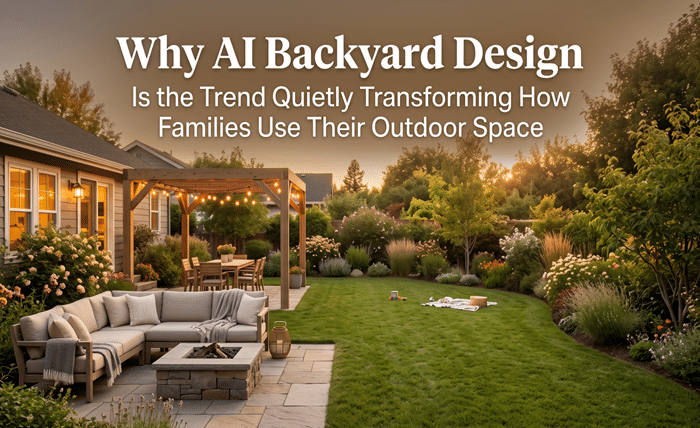
There is a moment every homeowner knows. You step onto your back porch on a warm evening, look out at the lawn, and realize the space you own is doing almost nothing for you. It is there, it is yours, and yet it sits empty most of the year. The barbecue is pushed against the fence, the kids play on a phone, and the patio chairs face a view nobody uses.
That is the gap AI backyard design is starting to close. Instead of hiring a designer or wrestling with landscape software, people are now uploading a single photo of their yard and watching it transform into a realistic, usable outdoor room in seconds. It has moved from a niche trick to a genuine home trend, and the reason is simple: it lets you see the life you want before you spend a dollar building it.
Why This Moment, Why Now
None of this is happening by accident. Three things converged to make AI backyard design a genuine trend rather than a passing novelty. First, the technology got good enough to produce photorealistic results from an ordinary phone photo — no special equipment, no training. Second, more people began working from home, which meant they spent more time looking at their own backyard and noticing how little they used it. Third, the cost of professional design stayed stubbornly high, leaving a wide gap between “I want to improve this space” and “I can afford to have it designed.”
The result is a tool that sits exactly in that gap. It costs nothing to try, needs no skill to use, and delivers a professional-looking preview in seconds. For a generation that already runs much of its life through a phone, this feels less like new software and more like an obvious missing feature.
What Actually Happens When You Use It
The workflow is deliberately simple, and that is part of why it spread so quickly. You snap or upload a clear daylight photo that shows the area you want to improve — fences, doors, trees, and edges all help. You pick a direction: relaxation, entertaining, family, dining, gardening, or a multi-use mix. Then you choose a style, and the generator produces a realistic render with planting, hardscape, furniture, and lighting layered over your real yard.
From there, iteration is the whole game. You can test a garden-first plan, a social patio, or a low-maintenance scheme from the same photo, then compare the results side by side. That ability to hold several futures up against each other is what turns a vague wish into a decision you can actually make.
The Shift From Backyard to Outdoor Room
For decades, the backyard was an afterthought — a patch of grass to mow and a place to store the grill. Today it is being treated as another room of the house, one with no ceiling. Families want dining areas, fire-pit corners, play zones, and quiet spots to read, all arranged with the same intention as a living room.
That is precisely what AI backyard design helps you do. The tool reads the structure in your photo — the house, fence lines, trees, paths, and open areas — and lays out furniture, planting, and hardscape around how you actually want to live outside. It is not a random filter; it is a way to test whether a dining table belongs by the kitchen door or whether the play lawn should sit in the sunny corner.
Six Different Backyards, Six Different Lives
The appeal of AI backyard design is that it adapts to wildly different goals. Here are a few of the scenes people create most often.
The entertaining backyard. For hosts who live to have people over, the tool can place a lounge near the house, connect dining to the kitchen, and add ambient lighting that makes the space feel finished after dark. Suddenly, the weekend barbecue has a proper stage.
The family backyard. Parents juggling kids and adults need zones. A generator can test a play lawn beside a shaded seating corner, so the little ones run while the grown-ups keep an eye on them without shouting across the yard.
The backyard with a pool. A pool is a big commitment, and a render helps you weigh a resort-style setting against the practical space needed for walking, seating, and screening — before the excavator shows up.
The backyard garden. For the green-thumbed, a render can layer seasonal color, raised beds, and a small pause spot into one cohesive view, so the garden feels like a destination rather than a chore.
The low-maintenance backyard. Not everyone wants to spend weekends mowing. You can preview a drought-tolerant, mulch-and-gravel scheme that asks for far less water and upkeep while still looking polished.
The small backyard. A compact footprint is the hardest to plan, because every choice has to earn its place. AI backyard design can show how zoning, layered edges, and right-sized furniture make a tight yard feel intentional instead of cramped.
Why Seeing Beats Describing
The most common failure in any home project is the gap between what one person imagines and what another builds. You tell a contractor you want “a cozy outdoor space,” and you get something that looks nothing like the picture in your head.
AI backyard design removes that gap by giving everyone the same image. You generate a render, show it to your partner, your landscaper, or your contractor, and the conversation instantly becomes specific. “Move the seating closer to the fence” is a much easier instruction to follow than “make it nicer.” The shared visual turns a vague wish into a clear brief.
From Scattered Screenshots to One Clear Direction
Before tools like this, people planned a backyard the hard way: they saved dozens of Pinterest images, each showing a different yard in a different climate with different furniture, and tried to stitch them together into a vision. It rarely worked, because none of those photos showed their space.
AI backyard design flips that process. You start with your own photo, so every render keeps your fence, your trees, and your actual dimensions in view. You are not imagining someone else’s yard; you are previewing yours. That single change is what makes the results feel actionable rather than aspirational.
The Cost Logic That Makes It Trendy
It is hard to overstate how much the economics drive this trend. A professional landscape plan can run into the thousands of dollars, and that is before materials and labor. Most homeowners never get past the sticker shock, so the project simply never starts.
A free AI backyard design tool changes that math. You can test multiple directions from the same photo without spending anything, then decide what is actually worth paying for. The savings often go straight back into the project — better plants, a real patio, or professional help on the parts that genuinely need it, like drainage or grading.
Backyard Design for Every Season
A backyard is not just a summer space, and the best plans account for the whole year. A render can help you picture how a fire-pit corner extends the season into autumn, or how evergreen structure keeps the yard from looking bare in winter. This forward-looking view is one of the quieter advantages of AI backyard design, because it prevents the classic mistake of building a space that only works for three warm months.
What It Cannot Do
It is worth being honest about the limits, because the trend is stronger when expectations are realistic. AI backyard design produces a visual concept, not a construction document. It cannot confirm drainage, verify utility lines, pull permits, or guarantee that a specific plant will thrive in your exact soil. Those are jobs for local professionals.
Think of the render as the first draft of a plan, not the final word. It helps you decide what you want and explain it clearly. The physical work — and the professional checks that come with it — still belongs in the real world.
Who Is Using It First
The early adopters are telling. Real estate agents use AI backyard design to show buyers what an empty or neglected yard could become, which can meaningfully shorten time on market. Landscapers use it to cut proposal time and show clients options in minutes instead of hours. And a growing number of everyday homeowners use it simply to stop guessing — to walk into a project with a picture in hand instead of a shrug.
Tips for Getting a Useful Preview
Like any tool, it works best when you feed it a good starting point. The most common missteps are easy to avoid once you know them. Shoot in soft daylight rather than harsh midday glare or night, because the generator needs to see the boundaries and structure of your yard. Keep the frame clear of people, cars, and close-up clutter. Use a wide angle that captures the whole area you want to rethink rather than a tight close-up of one corner.
Most importantly, treat your first render as a draft. The real value of AI backyard design comes from the second, third, and fourth pass — changing the style, swapping priorities, and refining the prompt until one version clicks. People who stop after a single attempt are leaving most of the tool’s value on the table.
From Preview to a Real Backyard
There is a natural next step that turns a render into a project. Once you have a version you love, save it and write down what matters most — the seating layout, the planting, the lighting, the privacy. Then share it with the people who will do the actual work. A landscaper can tell you quickly what is feasible, what it will cost, and where you genuinely need professional help for drainage, grading, or structural work.
This handoff is where a lot of home projects quietly die. Without a shared image, the homeowner describes one thing and the contractor builds another. With a render from AI backyard design, both sides are looking at the same picture, and the whole conversation becomes more honest, more specific, and far less expensive in the long run. It turns out the most valuable thing the tool produces is not a pretty picture — it is a clear agreement about what “done” looks like.
How to Get Started Tonight
The beauty of the whole thing is how low the barrier is. Take a clear daylight photo of your backyard, upload it, and generate a few variations. Change the style, adjust the priorities, or type a prompt describing exactly what you want. In minutes you will have something you can look at, share, and build toward.
The hardest part of any backyard makeover has never been the digging. It has always been knowing what you are trying to create in the first place. AI backyard design solves that problem for you, one photo at a time. Take the picture, make the preview, and let your yard finally start living up to the space it was always meant to be.