

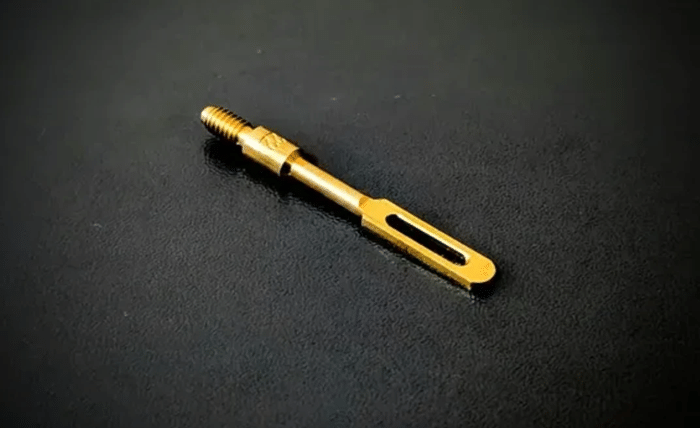
After firing, carbon, copper and lead stay behind in the barrel, and no single attachment can remove them all. First the deposits are softened with solvent, then scrubbed off with a brush, and finally the residue is wiped away with cloth. For the first and last of these steps, many shooters reach for a brass slotted tip: the cloth is threaded through the slot and slides freely along the rifling without bunching up. The brush and jag take over whenever the job calls for real scrubbing or a tight fit against the walls.
How Does the Process Begin
Before starting, the firearm is unloaded, the bolt is removed if the design permits, and a muzzle guard goes over the crown. The cleaning rod enters from the chamber end, and where that isn’t possible, a flexible cable is used. The first step is applying solvent. A wet patch on the tip makes two or three passes through the bore, and a slotted tip beats a jag here, since the solvent spreads in an even layer along the full length of the barrel. The solvent is then left for a few minutes to soften carbon and copper.
What Removes Stubborn Deposits
After the soak, a bronze bore brush that matches the caliber exactly goes into the bore. It is pushed all the way through until it fully clears the muzzle, and only then pulled back. Steel bristles aren’t suitable for this, as they scratch the rifling. The brush is rinsed afterward so fouling doesn’t dry in the bristles. A dozen passes usually loosen the fouling enough for a patch to pick it up.
How Do the Two Patch Holders Compare
With gun cleaning slotted tips, the cloth sits loose in the slot and travels both ways, so a folded patch can make the return trip on its unused side. A jag presses the patch tightly against the bore, travels only from breech to muzzle and has to match the caliber exactly. That’s why it’s used before or after a jag, not instead of one. Another plus is that one model covers a range of closely related calibers. A quick wipe after a range session, when there’s no time for a full cleaning, is another job it handles well.
Which Caliber Group and Cloth Size Suit a Given Barrel
Slotted tips for gun cleaning are made not for a single caliber but for a range of bore diameters. This cuts down the number of parts in a kit, but it means checking whether a given cartridge falls within the range. A typical lineup looks like this:
- .22 group – bores from 0.224 to 0.257 inches, patch about 1.5 inches;
- .30/.38 – from 0.277 to 0.357 inches, patch about 2 inches;
- .45/.40 – from 0.400 to 0.452 inches, patch about 2.5 inches;
- 12 GA – roughly 3 inches square, though an oversized piece doubled over works as well.
This lineup has no separate models for 20 gauge or .410. Rifle and pistol versions use an 8-32 thread, the shotgun version uses 5/16-27, and an adapter bridges the two. A patch that’s too large bunches up in the slot and jams, while one that’s too small never touches the rifling.
How Is the Barrel Prepared for Storage After Cleaning
Once dry patches start coming out clean, the bore is dried with a cotton mop. The final pass uses the same tip with a lightly oiled patch, leaving a thin protective film on the metal. In the field, an 8-32 tip can be attached to a flexible cable, allowing the patch to be pulled through from chamber to muzzle.
Brass is softer than barrel steel, so these attachments won’t scratch the rifling and can last for years. Plastic versions may crack over time, while brass holds its shape. A brush, slotted tip, jag and mop in the right calibers cover the bore cleaning process, from the first solvent pass to the final application of oil. With several barrels, having two or three tips per size saves the trouble of rinsing the same one between passes.