


Two weeks before her solo game’s demo was due at a small convention booth, Mara had a problem that had nothing to do with code. Her dungeon corridor looked fine from a distance and embarrassing up close. The stone walls were flat gray. The wooden support beams looked like plastic. She had built a functional, playable level with real gameplay in it, and it still looked unfinished, because nothing had any texture worth looking at. This is the story of how she actually fixed that, and what it taught her about what an AI texture generator can and can’t do under real deadline pressure.
The Realization That She Couldn’t Do This the Old Way
Mara had taken one texturing course years ago. She remembered enough to know that doing this properly, hand-painting convincing stone, wood, and metal across dozens of surfaces, was a multi-week job on its own, not a multi-day one. With two weeks left and half of that time needed for actual bug fixing, manual texturing simply wasn’t on the table. She needed something fast, and she needed it to not look obviously fake under booth lighting where people would be standing close.
The First Attempt That Taught Her a Real Lesson
Her first try was lazy, and she knew it even as she typed it. “Stone wall texture.” The AI texture generator gave her back something perfectly serviceable and completely forgettable, flat gray stone with no character, no sense of age, nothing that made it feel like it belonged in a dungeon anyone had actually walked through for centuries. It wasn’t bad. It just wasn’t anything.
The second attempt is where she actually learned something. She rewrote the prompt: “ancient damp dungeon stone, dark moss growth in the cracks, water staining running down from the top, rough uneven surface.” The difference was immediate and obvious. Specificity, it turned out, wasn’t a nice-to-have. It was the entire difference between a forgettable texture and one with actual atmosphere.
What She Noticed About the Maps She Was Actually Getting
Mara almost made a mistake a lot of newcomers make. She looked at the base color image, thought it looked great, and nearly moved on without checking anything else. A more experienced friend caught it and asked whether she’d checked the roughness and normal maps too, the ones controlling how light actually catches the surface once it’s applied to a real 3D object in-engine. She had it, without those working properly alongside the color, the stone would render flat under her engine’s lighting no matter how good the color image looked on its own. This turned out to matter enormously. A gorgeous color texture with a lazy, uniform roughness map still looked wrong once placed in the actual scene.
The Part Where Free Tier Limits Actually Bit Her
She was using a free AI texture generator, and for the first dozen textures, it didn’t matter at all. Around texture twenty, she hit a daily generation cap she hadn’t noticed in the fine print. That cost her half a day of momentum, waiting for the limit to reset, which taught her to batch her work more deliberately going forward, planning out exactly which textures she needed for the day rather than generating casually and iterating endlessly on each one.
Where the AI Genuinely Struggled, No Matter How She Phrased It
Her dungeon needed one very specific thing: an ornate, carved stone archway with a particular symbol repeated in a pattern around its border, something tied directly to her game’s lore. No matter how she described it, the AI texture generator kept producing generic decorative carving that didn’t match the actual symbol she needed. This was the moment she accepted a real limit of the tool. It excelled at generic, atmospheric materials, stone, wood, metal, fabric, and struggled badly with anything requiring a specific, non-generic design element tied to something only she knew the details of. For that one asset, she ended up hand-painting the symbol herself and blending it into an AI-generated base texture, combining both approaches rather than picking one exclusively.
What Her Finished Level Actually Looked Like
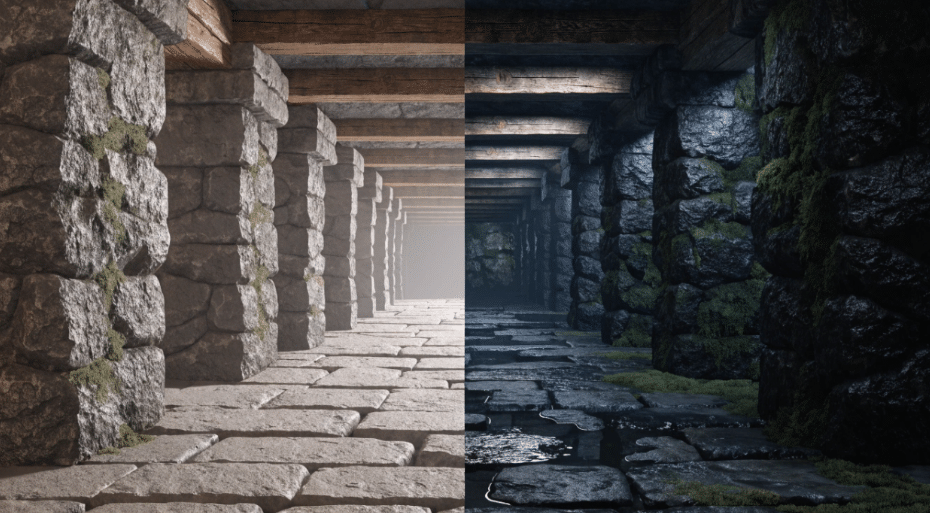
By the deadline, roughly ninety percent of her level’s surfaces were AI-generated textures, refined through a few rounds of more specific prompting once she’d learned what actually worked. The remaining ten percent, the lore-specific archway and a couple of other unique story elements, got manual touch-ups layered on top of AI-generated bases. Nobody at the convention booth commented on the textures at all, which she took, correctly, as the actual sign of success. Bad texturing gets noticed. Good texturing just disappears into a scene that feels real.
What She’d Tell Someone Starting From Where She Started
Don’t accept the first generation, ever. Write the vague version of your prompt, look at what comes back, then rewrite it with actual specific detail about age, wear, color variation, anything that gives the tool something concrete to work from instead of a generic average. Check every map that gets generated, not just the color one, because the roughness and normal maps are doing just as much work once something’s actually rendered in a real scene with real lighting. Know your tool’s usage limits before you’re twenty textures deep and suddenly blocked. And accept early that anything highly specific, a particular symbol, a very particular design tied to something only you know, probably needs a human hand finishing it, AI-generated base or not.
The Actual Lesson Underneath All of This
An AI texture generator didn’t save Mara’s project by doing everything. It saved her project by doing the ninety percent that didn’t need a specific human touch, freeing up her actual limited time for the ten percent that genuinely did. That’s really the honest shape of what this technology is good for right now: not a replacement for skilled texturing work, but a way to spend your real time and attention only where it actually matters, instead of everywhere at once.